



Choosing the right domain name is an important step in establishing a professional online presence for an architecture firm in Dubai. A domain name is more than a website address; it contributes to brand recognition, credibility, memorability, and how potential clients discover and identify your business online.
For architecture firms operating in Dubai’s competitive market, the right domain should reflect the firm’s identity, be easy to remember and communicate, and remain suitable as the business grows. From selecting between .com and .ae to considering brand consistency, local market relevance, and SEO implications, several factors should guide this decision.
In this guide, we explore how architecture firms in Dubai can choose a domain name that supports their professional identity, strengthens their digital presence, and provides a reliable foundation for long-term business growth.
For an architecture firm in Dubai, a domain name is more than a technical requirement for launching a website. It is part of the company’s professional identity and often one of the first elements potential clients encounter when searching for architectural services online.
In a competitive market like Dubai, where architecture firms work with developers, investors, contractors, and property owners from different countries, a clear and professional domain name can help establish credibility and make a business easier to recognize and remember.
The right domain also provides a consistent foundation for your website, business email addresses, digital marketing campaigns, and long-term online presence. Choosing it carefully from the beginning can help your firm build a recognizable brand and avoid unnecessary changes as the business grows.
Your domain name contributes to the first impression people form of your architecture firm online. A professional, clear, and relevant domain can make your business easier to identify and communicate a sense of consistency across your digital presence.
For example, a domain that closely matches your firm’s registered or recognized brand name is generally easier for clients, consultants, and business partners to remember. It also supports professional communication through branded email addresses, such as info@yourfirm.com, rather than generic email accounts.
This matters particularly when approaching high-value clients, participating in competitive tenders, or presenting your portfolio to developers and investors. Your domain alone cannot establish trust, but it can support the professional image your website, portfolio, and business communication are intended to convey.
Architecture is a visually driven and reputation-based industry. Clients often evaluate a firm’s identity through its completed projects, design approach, portfolio, and professional presentation before making contact.
A suitable domain name helps connect these elements under one recognizable brand. When your website, business email, social media profiles, and marketing materials use consistent naming, potential clients can more easily identify your firm across different platforms.
For architecture firms in Dubai that work with both local and international clients, this consistency is especially valuable. A distinctive and easy-to-remember domain can support brand recognition beyond the local market and make it easier for people to return to your website or recommend your firm to others.
Your domain name should support not only your firm’s current activities but also its future direction. An architecture business may expand from residential design into commercial architecture, interior design, urban planning, project management, or international projects.
Choosing an overly specific domain can make future expansion more difficult if the business later moves beyond its original services or target location.
A flexible, brand-focused domain gives your firm more room to grow. It can serve as the foundation for publishing project case studies, sharing industry insights, building organic search visibility, and developing a broader digital presence.
When these activities are connected through an integrated digital growth strategy, your domain becomes part of a wider system that helps potential clients discover your firm, understand its expertise, and build confidence in its work.
Ultimately, the right domain name is an early investment in your firm’s digital identity. When combined with a professional website, a clear content strategy, and a consistent online presence, it can contribute to a stronger foundation for long-term business growth. If you are planning to strengthen your firm’s digital presence, you can contact the Archora team to discuss the next steps.
A good domain name for an architecture firm should be memorable, professional, easy to communicate, and aligned with the company’s brand identity. It should help potential clients recognize the business without creating confusion about its name, services, or market position.
For architecture firms in Dubai, the domain should also work well in an international business environment. Clients, developers, consultants, and investors may come from different linguistic and cultural backgrounds, so simplicity and clarity are particularly important.
There is no single domain formula that works for every architecture business. However, several practical principles can help you choose a domain that supports your firm’s identity today and remains suitable as the company grows.
Shorter domain names are generally easier to remember, type, and share. A concise domain also works better across business cards, email signatures, project presentations, social media profiles, and marketing materials.
Try to choose a name that communicates your firm’s identity without unnecessary words. If your company already has a distinctive brand name, using that name as the foundation of your domain is often a practical starting point.
For example, a firm called “Apex Studio” might consider a straightforward domain based on its brand name rather than a long address containing multiple service descriptions and location terms.
The objective is not simply to create the shortest possible domain, but to find a name that people can recall and associate with your architecture firm.
Architecture firms in Dubai often communicate with international clients and partners. A domain that is difficult to pronounce, spell, or understand when spoken can create unnecessary friction.
Avoid unusual spellings, complicated abbreviations, and combinations of words that people may interpret differently. Consider how the domain sounds when someone mentions it during a meeting, a phone call, or a project presentation.
A useful test is to say the domain aloud to someone who has not seen it before. If they can understand it and write it correctly without repeated explanations, the name is likely easier to communicate.
Your domain should feel consistent with the identity your architecture firm wants to establish. A company focused on contemporary residential architecture may have a different brand personality from a practice specializing in commercial developments, hospitality, or urban planning.
However, your domain does not need to describe every service the company provides. In many cases, a distinctive brand name offers greater flexibility than a domain built around a narrow service category.
Before making a decision, consider whether the name fits your visual identity, company positioning, portfolio, and long-term business direction. A consistent identity across your professional website and other digital platforms can make your firm easier to recognize.
Numbers and hyphens can make a domain harder to communicate verbally and easier to mistype. They may also create uncertainty about whether a number should be written as a digit or a word, or whether a hyphen belongs in the address.
For example, a domain such as apex-architecture-dubai-24.com is more complicated to communicate than a simple brand-based alternative.
This does not mean every domain containing a number or hyphen is unsuitable. There may be legitimate branding or naming reasons to use them. However, unless they are essential to your firm’s identity, simpler alternatives are usually easier to manage.
Before registering a domain, read it as one continuous phrase and check whether it could be misunderstood, misspelled, or confused with another business.
Ultimately, a strong domain name should make your architecture firm easier to identify and remember. It should support your brand rather than compete with it, while leaving enough room for your business to develop in Dubai and beyond.
Choosing between a .com and .ae domain depends on your architecture firm’s target market, brand positioning, and long-term business plans. Both extensions can work well for a company based in Dubai, but they communicate slightly different things to potential clients and search engines.
A .com domain is widely recognized internationally and is commonly used by businesses serving clients across multiple countries. In contrast, .ae is the official country-code domain extension of the United Arab Emirates and can help communicate a clear connection to the local market.
Before making a decision, consider where your potential clients are located, how you want your firm to be perceived, and whether your business plans to expand beyond the UAE.
The .com extension is one of the most familiar domain endings worldwide. For architecture firms working with international developers, investors, consultants, and property owners, this familiarity can make a website address easier to recognize and remember.
A .com domain may be a suitable choice if your firm:
Works with clients in multiple countries.
Plans to expand into international architecture or design markets.
Wants a domain that is not strongly associated with one country.
Uses an international brand identity across its website, portfolio, and marketing channels.
For example, a firm with a distinctive brand name could use a domain such as studioexample.com to maintain a consistent identity across different markets.
However, choosing .com does not automatically make a business more credible or improve its search rankings. The quality of the website, portfolio, reputation, content, and overall digital presence remain important factors.
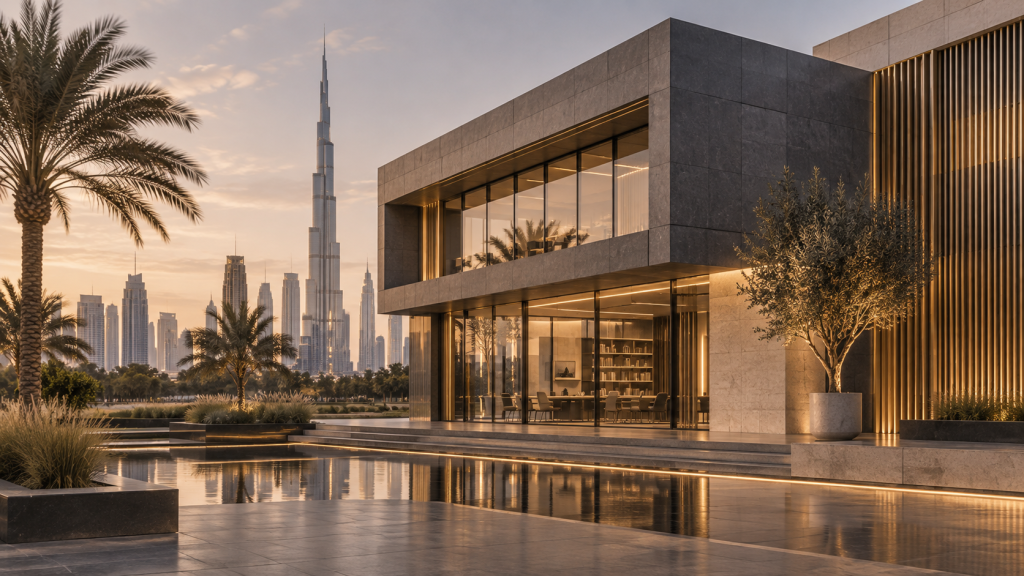
The .ae extension is the official country-code top-level domain of the United Arab Emirates. It provides a direct indication that a website is associated with the UAE, making it a relevant option for architecture firms primarily serving the Dubai and wider UAE market.
A .ae domain may be particularly suitable if your firm:
Focuses mainly on projects in Dubai or other UAE emirates.
Wants to establish a clear local business identity.
Targets property developers, contractors, and clients based in the UAE.
Wants its website address to reflect its connection to the local market.
For example, studioexample.ae can communicate a clear UAE association while keeping the firm’s brand name at the centre of its online identity.
There is also an SEO consideration. Google recognizes country-code top-level domains as a signal of the geographic market a website is intended to serve. Therefore, a .ae domain can help communicate a UAE-focused presence. However, it does not guarantee higher rankings, and relevant content, technical SEO, local relevance, and website quality remain essential.
If both domain versions are available, registering them can be a practical way to protect your firm’s brand identity and maintain flexibility for future growth.
For example, an architecture firm could register both studioexample.com and studioexample.ae, then choose one as its primary website address.
This approach can help:
Protect the brand from competing registrations of the same name.
Keep the domain available for future expansion or market-specific campaigns.
Reduce the risk of confusion when clients search for the company online.
Maintain control over alternative versions of the firm’s web address.
However, owning both domains does not mean you should operate two identical websites independently. Choose one primary domain and redirect the other to it using a permanent 301 redirect. This helps consolidate users and search signals around a single preferred website address.
There is no universal winner between .com and .ae. The right choice depends on your firm’s business priorities.
If your architecture firm mainly serves the UAE market and wants to emphasize its local presence, .ae is a strong option. If your business has international ambitions or already operates under a globally positioned brand, .com may be more suitable.
For firms that can secure both versions, registering both and selecting one as the primary domain can provide additional brand protection.
Most importantly, do not choose a domain extension based on SEO assumptions alone. Your website’s ability to attract and convert potential clients depends on a broader digital foundation, including professional presentation, relevant project content, search visibility, and a clear brand identity.
Including architecture-related keywords in your domain name may help visitors understand what your business does, but it is not a requirement for building a successful online presence. For an architecture firm in Dubai, the main priority should be choosing a domain that communicates the firm’s identity clearly, is easy to remember, and supports its long-term positioning.
Words such as architecture, architects, design, or studio can provide context, particularly for a new business whose brand is not yet widely recognized. However, adding keywords simply to influence search rankings is rarely a good reason to choose a domain.
The best approach is to balance brand identity, clarity, and search visibility rather than trying to include every relevant service or location in the website address.
Architecture-related terms can make a domain more descriptive. They may help potential clients understand the nature of your business before visiting your website.
For example, a firm might consider domain structures such as:
examplearchitecture.com
examplearchitects.ae
exampledesignstudio.com
These formats can be useful when the firm’s preferred brand name is already registered or when additional context is needed to distinguish it from businesses in other industries.
However, a domain does not need to describe every service the firm provides. If your company offers architecture, interior design, master planning, and project consultancy, trying to include all these terms can make the domain unnecessarily long and difficult to remember.
Choose a descriptive word only when it improves clarity without weakening the brand name.
An important decision is whether to prioritize your firm’s distinctive brand name or use a domain built around a specific search phrase.
For example, consider two hypothetical approaches:
Brand-focused: studioexample.com
Keyword-focused: architecturefirmdubai.com
The first emphasizes a recognizable business identity, while the second describes a service and location more directly.
For an established or ambitious architecture firm, a brand-focused domain is often the more flexible choice. It can accommodate new services, different project types, and expansion into other markets without requiring a change to the website address.
A keyword-focused domain may appear descriptive, but it does not automatically establish credibility or distinguish the firm from competitors. A strong portfolio, clear positioning, and consistent brand presentation are more meaningful ways to communicate professional value.
Domain names are one small part of a website’s overall SEO foundation. Including a keyword such as architecture or Dubai does not guarantee better rankings for searches related to architectural services.
Google’s guidance makes clear that keywords in domain names are only one of many considerations, and its exact-match domain system is designed to prevent websites from receiving excessive ranking credit simply because their domain matches a search query.
For architecture firms in Dubai, a more sustainable SEO approach is to:
Use a clear and consistent domain that represents the firm’s brand.
Create dedicated service pages for architecture, interior design, and other relevant services.
Publish informative content that addresses the questions and needs of potential clients.
Develop detailed project pages that demonstrate expertise and completed work.
Maintain a technically sound website with clear navigation and descriptive page URLs.
Your domain should establish a reliable digital identity; your website content should communicate your expertise and target the relevant search queries.
This is why domain selection should be considered alongside professional website development and a broader integrated digital growth strategy, rather than treated as an isolated SEO decision.
Ultimately, choose architecture-related keywords only when they make your domain clearer and more meaningful. A memorable brand name supported by a well-structured website and relevant content is a stronger long-term foundation than a domain designed solely around search terms.
Once you have selected a suitable domain name for your architecture firm, the next step is to check whether it is available and register it under the correct ownership.
For businesses in Dubai, this process involves more than finding an available web address. You should also check for potential brand conflicts, choose an appropriate registrar, understand the registration requirements, and make sure your company retains control of the domain.
Taking these steps before launching your website can help prevent ownership disputes, unnecessary costs, and avoidable changes to your digital identity later.
Start by checking whether your preferred domain is available through a domain registrar or an official registration service.
You can search for both .com and .ae versions of your chosen name to compare availability and registration options. If your first choice is already registered, consider a simple variation that preserves your firm’s brand identity rather than adding unnecessary numbers or complicated wording.
When checking availability, consider the following:
Search for the exact brand name in your preferred domain extension.
Check alternative extensions such as .com and .ae.
Look for spelling variations that clients might naturally use.
Check whether similar domain names could create confusion with another business.
Compare registration and renewal costs before making a decision.
For .ae domains, registration is handled through accredited registrars operating under the UAE’s domain administration framework. You can consult the official .ae domain information from the UAE Government to understand the local domain system.
Remember that domain availability can change at any time. Confirm the current status immediately before registration.
An available domain name is not necessarily a name your company should use. Before registering it, check whether another business is already using a similar name or has trademark rights that could create a conflict.
This is particularly important in Dubai’s competitive architecture and construction market, where firms may operate under similar names across related industries.
Before proceeding:
Search for the proposed brand name online to identify businesses using the same or a similar name.
Check relevant trademark records in the UAE.
Review the name of your intended domain against your company’s registered trade name.
Consider whether the name could be confused with an existing architecture, engineering, or design firm.
Seek professional legal advice if you identify a potential trademark conflict.
A domain registrar’s availability check does not replace a trademark search. Registering a domain does not automatically give your company trademark rights over the name.
After confirming that the name is suitable, select a registrar that can provide the domain extension you need and manage it reliably.
For a .ae domain, use an accredited registrar listed through the UAE’s official domain administration channels. For a .com domain, choose an established registrar with transparent pricing, renewal policies, and account security features.
Compare providers based on:
Initial registration and annual renewal fees.
Domain management and DNS configuration options.
Account security, including two-factor authentication.
Renewal notifications and automatic renewal settings.
Customer support and domain transfer procedures.
Access to domain ownership and registration records.
Avoid choosing a provider based only on the lowest introductory price. Renewal costs, account access, and reliable support are important considerations for a business domain.
One of the most important steps is ensuring that the domain is registered in the name of your architecture firm or its legally appropriate owning entity.
In some businesses, a website developer, marketing agency, or employee registers the domain on behalf of the company. This can create problems if the relationship ends and the business does not have direct control over the registration.
To protect your firm’s ownership:
Use the company’s legal name and appropriate registration details as the registrant.
Keep the domain account under a company-controlled email address.
Ensure authorized company representatives have access to the registrar account.
Store registration details and renewal information securely.
Enable automatic renewal where appropriate and keep payment details up to date.
Maintain control over DNS settings and domain transfer authorization.
Your web development or marketing partner can manage the technical setup without becoming the legal registrant or sole account holder.
This distinction matters because your domain is a long-term business asset. Your firm should retain control even if its website provider, marketing agency, or internal team changes.
After registration, the domain needs to be connected to your website through its DNS settings. Your hosting provider or web development team can guide you through the configuration.
The setup usually involves:
Pointing the domain’s DNS records to the correct hosting service.
Configuring the preferred website version, such as www.example.com or example.com.
Setting up HTTPS with a valid SSL/TLS certificate.
Configuring professional email addresses using your domain.
Redirecting alternative domain versions to one primary website address.
Verifying the website in Google Search Console and submitting the XML sitemap.
These steps help ensure that visitors can access the website securely and that search engines can discover and understand its preferred domain.
For architecture firms, domain registration should be treated as the beginning of the digital setup, not the completion of it. A well-configured domain needs to support a professional website, a clear project portfolio, and the content that communicates the firm’s expertise to potential clients.
Choosing a domain name may seem like a simple technical decision, but the wrong choice can create branding, communication, and management problems for an architecture firm.
In Dubai’s competitive architecture market, your domain should make your business easy to recognize, remember, and find. A poorly chosen name can weaken brand consistency, create confusion among potential clients, or become restrictive as your company grows.
Understanding the most common mistakes can help you avoid unnecessary changes and establish a stronger digital identity from the beginning.
A domain name should be easy to read, spell, pronounce, and share. Complicated combinations of words, unusual spellings, unnecessary abbreviations, and long phrases can make it difficult for potential clients to remember your website address.
This is particularly relevant for architecture firms in Dubai, where clients and business partners may come from different linguistic backgrounds.
For example, a domain containing several hyphens, numbers, or unfamiliar abbreviations may be harder to communicate during meetings, presentations, and business conversations.
Before registering a domain, ask yourself:
Can someone remember it after hearing it once?
Can they spell it correctly without seeing it written?
Does it sound professional when spoken aloud?
Is it easy to type on a mobile device?
Could it be confused with another business name?
If the answer to several of these questions is no, consider a simpler alternative.
Domain naming trends change over time. A name that seems modern today may become dated or unsuitable as your architecture firm develops.
For example, choosing a domain based on a temporary design trend, popular abbreviation, or fashionable keyword can limit the firm’s identity in the future.
Architecture businesses often evolve. A firm may begin with residential projects and later expand into commercial architecture, interior design, urban planning, or international developments.
A domain built around a temporary trend or narrowly defined service may no longer represent the company’s capabilities.
Instead, prioritize a distinctive name that reflects your firm’s identity and can remain relevant as its services, portfolio, and target markets expand.
Registering a domain without establishing clear ownership is one of the most avoidable mistakes a business can make.
If a developer, employee, or external agency registers the domain using a personal account, your architecture firm may face difficulties accessing or transferring it when the working relationship changes.
Similarly, failing to monitor renewal dates can result in an expired domain, interrupted website access, and potential loss of control over the web address.
To prevent these problems:
Register the domain under the company’s appropriate legal ownership.
Use a company-controlled email address for the registrar account.
Keep login credentials and recovery information secure.
Enable renewal notifications and maintain valid payment details.
Review domain ownership and access permissions periodically.
Your domain is part of your firm’s digital infrastructure. It should be managed with the same care as other important business assets.
A domain name should represent your business without unnecessarily restricting its future direction.
For instance, a firm that uses a domain focused exclusively on one neighborhood, project type, or architectural service may find it less suitable when entering new markets or offering additional services.
Consider an architecture firm in Dubai that initially specializes in residential villa design but later takes on commercial developments and projects in other countries. A domain tied too closely to its original niche may no longer communicate the full scope of the business.
A more flexible, brand-focused domain can accommodate:
New architectural and design services.
Different project categories and market segments.
Partnerships with international developers and consultants.
Expansion into other cities or countries.
A broader portfolio and professional reputation.
The goal is not to make the domain vague, but to choose a name that is specific enough to establish a recognizable identity and flexible enough to support business growth.
Ultimately, avoiding these mistakes helps your architecture firm establish a domain that is practical, professional, and sustainable. Combined with a well-designed professional website and a consistent digital growth strategy, the right domain can become a reliable foundation for your firm’s long-term online presence.
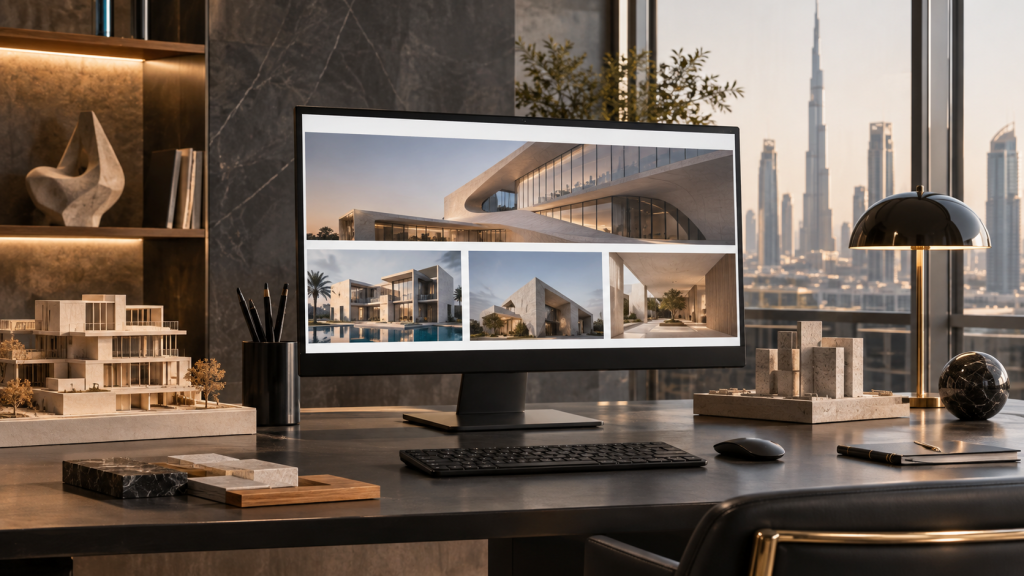
The best domain name strategy depends on an architecture firm’s brand identity, target market, services, and long-term business objectives. A firm focused on residential projects in Dubai may approach domain selection differently from an international architecture studio working across several countries.
Rather than following a single naming formula, architecture firms should choose a domain structure that reflects how they want clients to recognize and remember their business.
The following examples illustrate three practical approaches.
For many architecture firms, using the established business or studio name as the domain is the simplest and most flexible approach.
For example, a hypothetical firm called Atria Studio could consider:
atriastudio.com
atriastudio.ae
atriaarchitecture.com
This strategy puts the brand at the centre of the firm’s digital identity. It also makes it easier to maintain consistency across the website, business email addresses, social media accounts, project presentations, and marketing materials.
A brand-focused domain is particularly suitable for firms that want to build recognition over time, develop a distinctive portfolio, and potentially expand into new architectural or design services.
Before choosing this approach, check whether the brand name is available in the relevant domain extensions and whether it creates conflicts with existing businesses or trademarks.
Another strategy is to combine the firm’s brand name with a relevant service or geographic term.
For example, a hypothetical architecture company named Atria that primarily serves Dubai might consider:
atriaarchitecture.ae
atriadubai.com
atriaarchitects.ae
This approach can make the firm’s business activity or geographic association clearer, particularly when the brand name alone does not communicate what the company does.
It may be useful for newly established firms that are still building brand recognition in Dubai or for businesses whose names are shared by companies in unrelated industries.
However, location and service keywords should only be added when they improve clarity. A domain that becomes too long or restrictive may be less effective as a lasting brand asset.
Architecture firms with international ambitions may prefer a distinctive brand name that does not depend on a particular service or geographic location.
For example, a hypothetical studio called Forma Atelier might consider:
formaatelier.com
forma-studio.com
formaatelier.ae
This approach allows the firm to build a recognizable identity that can work across different markets, project categories, and professional partnerships.
A distinctive name can also provide more flexibility when the business expands beyond its original location or develops new services.
For international architecture firms, it is important to check that the chosen name is easy to pronounce and understand across the languages and markets relevant to their clients.
Each approach offers different advantages. The right option depends on the firm’s current position and future direction.
| Domain strategy | Best suited for | Main advantage |
|---|---|---|
| Brand-focused | Established or growing firms | Builds long-term brand recognition |
| Brand + architecture or location | New or locally focused firms | Communicates services or market relevance |
| Distinctive international brand | Firms targeting multiple markets | Provides flexibility for expansion |
These examples use hypothetical brand names and domain structures; their availability and trademark status have not been verified.
The most effective choice is one that balances memorability, professional identity, and flexibility. Your domain should make it easier for potential clients to recognize your firm, while your website and portfolio demonstrate the quality of your architectural work.
A strong domain is only one part of that process. It should work alongside a professional website, relevant project content, and a consistent brand presentation as part of a broader Hybrid Growth System.
Choosing the right domain name is an important first step, but its real value comes from how effectively it supports your architecture firm’s wider digital presence.
For architecture firms in Dubai, attracting potential clients requires more than having a website address. Your domain should connect your brand identity, website, project portfolio, search visibility, and digital communication under one consistent presence.
When these elements work together, they make it easier for potential clients to discover your firm, understand its expertise, evaluate its work, and eventually get in touch.
Your domain is the foundation of your firm’s website and often the starting point of its online customer journey.
A professional architecture website should do more than introduce the company. It should communicate the firm’s design approach, showcase completed projects, explain its services, and make it easy for potential clients to take the next step.
For example, a well-structured website can include:
A clear homepage that introduces the firm’s identity and positioning.
Dedicated service pages explaining architectural and design capabilities.
Detailed project pages demonstrating completed work and expertise.
An about page presenting the team, experience, and approach.
Contact information and clear inquiry options.
The domain should be consistent with the firm’s brand and provide a memorable address for all these resources.
A carefully developed professional website gives your domain a meaningful purpose: turning an online address into a platform where potential clients can evaluate your firm and explore its capabilities.
A registered domain does not automatically attract organic traffic. Search visibility depends on the quality, relevance, and technical performance of the website and its content.
For architecture firms in Dubai, an effective SEO and content strategy can help the business appear when potential clients search for architectural services, design expertise, project references, or industry information.
Your website can support this strategy through:
Search-optimized service pages targeting relevant client needs.
Project case studies that demonstrate practical experience.
Informative articles answering common questions about architecture and construction.
Descriptive page titles, URLs, and internal links.
Technical SEO improvements that help search engines crawl and understand the website.
For example, an architecture firm specializing in commercial projects can publish detailed project pages and useful articles related to commercial architecture, workplace design, and development considerations.
Over time, this content can help establish topical relevance, demonstrate expertise, and attract visitors with a genuine interest in the firm’s services.
The domain provides a consistent destination for this content, while SEO helps potential clients discover it.
Your domain should not operate independently from the rest of your firm’s digital identity.
Potential clients may discover your architecture business through Google Search, LinkedIn, YouTube, Instagram, industry directories, or recommendations from professional contacts. They should be able to recognize the same business across these different channels.
Maintain consistency by:
Using the same brand name and visual identity across platforms.
Including your official website address in social media profiles.
Using branded business email addresses.
Linking relevant social media content to appropriate website pages.
Maintaining consistent company descriptions and contact information.
Sharing project portfolios and professional insights under the same brand identity.
For architecture firms targeting developers, investors, and international clients, this consistency helps create a more coherent and professional impression.
A domain name, website, SEO strategy, content production, and social media presence deliver greater value when they support the same business objectives.
This is the principle behind Archora’s Hybrid Growth System: connecting different digital capabilities into a coordinated approach that helps valuable businesses become easier to find, understand, and trust.
For an architecture firm in Dubai, this can mean combining:
Website development: Building a professional platform that presents the firm’s identity, services, and portfolio.
SEO: Improving visibility for relevant searches and attracting qualified organic traffic.
Content marketing: Publishing useful articles, project stories, and industry insights.
AI-powered content and video production: Developing engaging visual and written content that communicates the firm’s expertise.
Digital branding and social media: Maintaining a consistent presence across platforms such as LinkedIn and YouTube.
Each element has a distinct role, but the website and domain provide a central destination where these activities can lead potential clients.
The objective is not simply to increase website traffic or publish more content. It is to create a connected digital presence that supports brand recognition, builds credibility, and generates meaningful business opportunities.
For architecture firms looking to strengthen their market position, the right domain name is therefore not just a registration decision. It is the starting point of a broader digital growth strategy.
Before registering a domain for your architecture firm in Dubai, take a moment to review your final choice. A good domain should represent your business professionally, be easy to remember, and remain suitable as your company develops.
Use this checklist to make sure you have considered the most important factors.
Brand Identity and Memorability
Does the domain reflect your firm’s brand name or professional identity?
Is it short, clear, and easy to remember?
Is it easy to spell, pronounce, and communicate?
Does it avoid unnecessary numbers, hyphens, and complicated wording?
Will it remain relevant if your services or target markets expand?
Domain Extension
Have you compared the suitability of .com and .ae?
Does your chosen extension reflect your target market and business positioning?
Have you checked whether alternative versions of the domain are available?
Would registering both .com and .ae help protect your brand?
Availability and Legal Considerations
Have you confirmed that the domain is currently available?
Have you checked for similar business names and potential trademark conflicts?
Does the proposed domain align with your company’s registered or recognized business name?
Have you reviewed the registration requirements for your selected extension?
Ownership and Management
Will the domain be registered under your company’s appropriate ownership?
Will your firm control the registrar account and recovery email?
Have you reviewed registration and renewal costs?
Are renewal notifications and account security settings properly configured?
Does your company retain access to DNS settings and transfer authorization?
Website and Digital Presence
Can the domain support a professional business email address?
Will it be used consistently across your website and digital platforms?
Have you planned the primary domain version and necessary redirects?
Will the website use HTTPS and have correctly configured DNS records?
Does the domain support your broader website, SEO, and content strategy?
If your chosen domain meets these criteria, you are in a much stronger position to register it and use it as the foundation of your firm’s digital identity.
Remember that the best domain is not necessarily the one with the most keywords or the longest description of your services. It is the one that communicates your brand clearly, works for your target audience, and gives your business room to grow.
Once your domain is secured, the next step is to build a professional online presence around it. A well-planned website, strong project portfolio, relevant content, and coordinated digital marketing can turn a simple domain into a valuable business asset.

Choosing the right domain name is an important step in establishing your architecture firm’s online identity. However, a memorable website address is only the beginning. To attract potential clients, communicate your expertise, and build lasting credibility, your digital presence needs to work as a connected business system.
For architecture firms in Dubai, this means combining a professional website, search engine optimization, high-quality project content, visual storytelling, and consistent digital branding.
At Archora Studio, we help valuable businesses become easier to find, understand, and trust through our Hybrid Growth System.
Our approach connects:
Website Design and Development: Creating professional websites that communicate your firm’s identity, services, and architectural portfolio.
SEO and Search Growth: Improving your visibility in relevant searches and helping potential clients discover your expertise.
AI Content Production: Developing strategic website content and industry insights that communicate your value.
AI Video Production: Transforming architectural projects, services, and brand messages into engaging visual stories.
Branding and Social Media: Building a consistent digital identity across platforms such as LinkedIn and YouTube.
Rather than treating these activities as separate marketing tasks, the Hybrid Growth System connects them around a shared objective: creating a stronger digital presence that supports business growth.
Explore the Hybrid Growth System to discover how these capabilities can work together for your architecture firm.
If you are ready to strengthen your firm’s digital presence and create new opportunities in Dubai’s architecture and construction market, contact the Archora team to discuss your business goals.
Archora Studio helps architecture, construction, and urban development firms attract high-value clients through strategic SEO, industry-focused content, and digital growth solutions. We turn specialized expertise into digital visibility, trust, and business opportunities.